My dear Mace --
It is hard to know,
to realise that I am call-
ing you so for the last
time. You who have been
almost my very life for the
past two years and whom
I have loved so dearly, so
truly, but so it is avid
I realize fully what I am
doing when I ask you to
release me from my engage-
ment and to give me back
all my promises._ Of the
unhappy days & hours
I have spent mace of the
struggle, the hardfight
I have had you can never
(next side: here on denoted by a blank line.)
never know. The little laugh
I have taken off, the pledge
of your love for me & your
engagement gift and I
ask to be free again.
My love Mace, for you was
deep, strong and true and
would have remained so
to the end and the two years
would have seemed almost
nothing to have waited
had I, could I only have
had perfect trust and
faith_had you been
worthy of my trust. You
would have found me
at your return, faithful,
loving and true. But
I have just learned from
undoubted and unques-
tionable authority, that you
were neither candid or
truthful to me last Summer
in regard to your Pledge
and that, not-with-stand-
ing your statement and
"word of honor" to the contrary
you did violate and
break it while you were
in Toledo last year and
that you did drink__
Mace, Mace why did you
so deceive me? The truth
I might and would have
forgiven, but the falsehood
never. then too a number
of other things have come
to my knowledge, since
my return home, which
convinces me that there
can be naught save un-
happiness and worry for
us in the future, as there
has been in the past. for
I know now, beyond a
doubt, that you intended
to deceive me and told
me an untruth and the
trust and faith I have so
prayed for, tried so hard
to feel for an in you, I
can never have and you
know, as well as I, that
a marriage where confi-
dence and perfect faith
is lacking no matter how
strong the love, there could
be but years of misery
and much apprehension for
us both. Therefore Mace
after a long and earnest
talk with Papa, I have_
after many hours of real
anguish and unhappiness
made up my mind to
break my engagement
and I know I am doing
right. Don't think of or
judge me too harshly
and if I have been unjust
or unkind ever forgive me,
forgive Elise, whom I know
you have loved so fondly
so dearly. Had I been
braver, stronger, I should
have learned the truth
and satisfied myself of
all this long ago, but I
loved you and I feared to
know the truth, for I did
so want to trust and
believe in you. Mace, Mace
why were you not candid
and honest with me. I
cannot say more, it is use-
less to do so. I have thought
over it, prayed over it and
decided fully now and
forever, and I know my
only happiness lies in the
course I have taken.
I beg Mace, that all my
little gifts you will keep
for they were all intended
only for you and it was
with a heart full of love
that I sent each and every
one of them to you and I
really want and wish
you should keep them.
But my letters I want
and I wish you would
at your first opportunity
return them. The little
bangle, which has been
my constant companion,
since the minute of its re-
ceipt, I have taken off and
put back in its pretty box
and will send it, together
with your letters, if you
wish them, to wherever
you direct. Mace, Mace,
Mace, good-bye. good-bye
forever.
Elise
#5 Moxahala Ave.
Saturday, March 30, 2013

Shufeldt's Creative Side
Front of Letter 1
Words on the ribbon:
"There is a little cherub t to looks out for poor Jack."
[He picks up a monkey which he names Jack later on in his journey. Could be the same one. He writes Elise of Jack occasionally. There is a long letter about Jack when the monkey falls overboard. Mace is quite sad because the ship kept going and let him drown. He does not get a new monkey.]
Words on the banner:
"As slow our ship her foamy track-
Against the wi was clearing
Her trembling p nant still looked back.
To that dear land twas leaving;
So loath to part from all we love;
From all the links that bind us;
So turn our hearts as on we rove.
To those we've left behind."
Excerpts from March 4th
".....one realizes
how deeply the sense of exile in
each meditation moment in the
vastness of moonlit sea about
him and grand expanse of God's
starlit space above......"
".....The sea--the vast, trembling, glittering
sea -- flashes back in each wave the
two thousand soft lights from a cloudless
starlit sky_ it's indescribable space
impresses one with such a sense of
majesty & of strength that as
you lean back in your chair to
watch the curling smoke arise - you
can but feel the presence, in
everything about you, of that Great
Being who holds it all in the
hollow of His Hands. Alone! Alone!..."
The make-up of the Envelopes
They are a mod podge of lined writing paper, plain thin paper, and thikc cardstock that have been glued and folded into beautiful patterns. It is thick on the edges to protect the letter, but thin where the address is written. He writes in beautiful calligraphy on the front of them. These are even apart of the artistic piece he prepares for her.
Shufeldt for Tuesday
Hello All,
I am so excited about this collection. I have not marked anything in the letters for you to look at specifically. I am going to provide quite a few transcriptions of random letters. I would like you to look at the art work and make up of the entire collection from the letters to the envelopes. We will be focusing on their relationship and different aspects of that. His writing is a little more difficult to make out, so I don't expect anyone to transcribe an entire letter. If you just have time to read what I have posted and browse the collection, I will be ecstatic. If you do feel like attempting to read some on your own:
March 8 - Letter 3 - topic of "Why Elise" when he has been with so many other women, but she captivates him.
March 7 - Letter 3 - discusses how long it has been since communication and wonders if she still loves him as much as he loves her.
Feb 25 - Letter 3 - writes of what he would do if they broke up in a sense
Feb 5 - Letter 2 - writes of his views on African culture which amount to the men are lazy and that the women have taken on the role of the worker.
Jan. 6 - Letter 1 - tells her that she will only get one love like this in her lifetime and nothing will ever come close to him.
Dec 30th - Letter 1 - talks of their relationship
Dec 29th - Letter 1 - discusses his role and job on the ship.
Now, don't immediately think that this man is a horrible person with the descriptions I have put above. The majority of the letters are adoring and loving in the entirety. Have a great weekend!
PS: Some notes on his writing:
--The symbol that looks like a cursive L is an and symbol
--The word same looks like sauce throughout the letter
--The crosses on the 't's are floating farther along generally (especially in Elise's letter)
Feel free to email me or blog post questions! Magnifying glass may be helpful.
Friday, March 29, 2013
Mason A. Shufeldt 01-16-1883
My Room Janry
16th 1883
My dear heart there are times in the lives of us
all whencalm contemplation is no longer possible. When our senses
our passions carry us away with wonderful force and
little discretion to the minds. I am – this night-
under such an influence, so afraid am I of my
self that I think best to discuss the most quiet of
subjects and easy of topics. Shall I? – Well _ the
weather! the weather _ it is so much better and brighter
and fair. Indeed, I enjoy this kind of weather
very much indeed. The sky is so clear and pretty,
the sea so smooth and sparkling, the air so
balmy and sleepy; the seal-gulls’ twitter so
melodious – well no, not exactly that - not ever-
thing is charming and I am so happy and
content in my love for you. My earnest, honest,
calm, fierce, absorbing love for darling old dear
Elise. I wish I had her far closer to me here that
I could feed my hungry lips upon her cheeks
and mouth. That I could look deep for the secrets
of her heart in those blue eyes of hers. That
I could have whispered in my ears the one word
I yearn, yearn, yearn to gather from her lips.
Then my wife, would I wind my strong arms
about you_ Can I not hold tight?_link my
fingers behind you_hold you! Yes and Kiss
your dear face my love a thousand times_ can
I? Will I ever? As certain as you breathe if
You are as I Know you are. Won’t I make love
to you_when we are married? I wonder if you
will ever tire of me. The quiet, stilly hours_
when each close wrapped in the other’s tight
embrace_ our hears hot beating against each
the others hotter breasts_ our lips seeking kisses
warm and true_my wife_my wife Elise
I must’nt write anymore_do you know why?
Goodnight and God bless and keep you ever.
Mason Shufeldt 01-03-1883
At night in my room Janry 3rd 1883
At sea
Such a dream, such a dream I had of you Elise
this afternoon. I was tired after a very long night
watch so took in my pretty little room with
all the curtains drawn and everything dark.Shall I tell it to you or would it be “not quite
that way Mace”_ I am a little afraid to
write you too much love Elise_not that I am
afraid of violating the measures of propriety, but
you too my darling are sometimes liable to
misconstrue things, though I try never to
accuse you of anything, that ever I may
sometimes think. I’ll risk it this time and
tell you. I dreamed that in some way we
had quarreled and that I was very very
unhappy. I thought that I could see you far
off somewhere I could not tell exactly
where, but I could see you plainly in the
same cloth dress and big hat I know so
well. Everytime I looked towards you, you
looked away from me and I had that
horrible feeling of separation and bitter
unhappiness that often oppresses our
thoughts in dreams_life! I seemed to be
struggling with something and then passed
before me that faces of many people I knew
or have known_some smiled at me some
laughed and I felt myself sinking
sinking down somewhere, then all became
confused and dark and roaring in my
ears and before my eyes and then still
and quieter and peaceful and I felt
distinctly against my ear the soft lips
of some person and upon my cheek the
soft breath of a woman. I slipped
my hand down the bare arm that touched
my shoulder and interlaced with my
fingers the clinging hand they reached.
Then Elise we pressed our faces close
together and sealed our lips with warm
kisses many and between each kiss
I thought you touched my heart with
Love while I flung both strong arms
around you, felt your heart beat
against mine in mad frolic at the
touch. I struggled fiercely with a
you . How much _ how fiercely_ but I could
not find the words. I could only press
you to my breast_hold you there while
my hungry lips wandered over cheeks that
were warm with love, eyes that were closed
in still happiness, hair that loose and
tangled fell upon my encircling arms.
I am not going to tell you any more. I
am afraid to write of my wild passionate
dreams to you, but I have these all the
same and they give me an insight into
my own nature that I better keep to myself
until later when I come home and
something happens. We are far at sea
as I write. I have made at the end of
this letter a little chart which includes
the ocean span from Norfolk to the
Cape De Verde Islands. This little map
shows the surrounding countries and
oceans. On the opposite page is a graph
of latitude, and longitudes taken each
day at noon, which each day I will plot
on the chart and thus actually spot our
position corresponding to the journal I
write each day to you. So you can see at
a glance exactly I what part of the
world or the ocean I was when I wrote certain
things to you. Don’t you think the idea a
pretty one darling? I do. I have allowed my
self a page each day to write. That will about
fill this letter at the time of our arrival.
I have much exceeded my allowance today.
I love you_ I love you_ I love you better
far than my life. My wife that is to be
I love you_ goodnight_ God bless you.
Thursday, March 28, 2013
Mason A. Shufeldt Transcription
This is the first day of the first journal letter.
Lynn Hareu Bay
Off Cape Henry Dec 27th 1882
Virginia Night In my Room
My darling Elise --
Before writing anything about our leaving
and up to the date at the head of this my first foreign
letter to you. I ant to explain my plan. The one I
intend to pursue from now until in the list is all
over. From the day we leave one port until we arrive
at the next where there is any mail communication
at all. I shall keep a regular journal; write some
thing every day to my far off sweetheart. each of
these letters will be arranged in the same way as
this on. Bound, with some sort of rough skick
on the fly leaf and always numbered. Now if you
follow the same plan we can tell immediately when we
lose anyone. I shall keep to this rule faithfully.
It's not expect that you will or can read such a letter
as this through in one day. You must make it last
longer than that. I estimate that it will be in the
vicinity of a month before the close of this letter. Many
sea days of cruise, and I shall mail it the
day we arrive at the Cape De Verde Islands. The day we
left Norfolk "all was bustle" indeed. The sailing a full
all cause suddenly. I pushed on shore at the very last
moment and got together all my photographic imple-
ments and took the opportunity to send off, "smal"
fairwell telegrams, as well as a very hurried note
to you my dear love. I found a letter from Father
in which I read quite a startling piece of news.
He says that after all I may see him in the
East as after the justification of the Corean Treaty by
the Senate, he may be made the Envoy to that country
to carry it our. To establish legation in the Coreans
copilate so. He seems quite enthusiastic on the subject
and I should not be at all surprised if things turned
out that way. In this case I should make very
strong efforts to join him and I think with every
chance of success. Then I should come home with
him much earlier that at present arranged. This
is in confidence you must remember. All my letters
to him now will be to influence him to listen to that
suggestion and my letters have very much influence
on him. Each new day seemed to give birth to some
new idea my sweet Elise, and some of them must
bear fruit sooner or later. Now, the ship left the
red town of Norfolk and ran down here, to an anchor.
Lynn Harem Bay is 22 miles from Norfolk and
only five miles inside of Cape Henry, beyond which
stretches the mighty Atlantic. from an anchorage
here we can plainly see the long sandy Cape, the
Virginia. Practically we might as well be far at
sea. as all the reminders of the land in have
left is some white sail is steamers smoke bound
(page 2)
of the hard Chesapeake. Many of us have written short
letters as I to you in the apparently vain hope to have
some passing vessel to carry them up. Our object in
anchoring here is to correct our compasses away from
the near vicinity of land, and as that correction depends
on a clear day or two, a blessing we have not yet
enjoyed, it looks as if our detention here would
amount to several days yet. So I am off at last!
Already I feel the strength, the bitterness of the trial
For myself I have no fear. But you are a woman,
by nature the weaker and not used to long sepera-
tions or fretting against the rougher side of the
world's experiences. But by nature too, your heart
should not only be the more Love, has made harder
and firmer to Love's trials. I have the utmost
and entire reliance in your honor and faith. I Know
how hard it is dear heart. I Know the strain. The
restless hours. the gloomy and desponding thought.
You cannot tell me more than I already know. __
But it will come to an end someday. That is as certain
as we both live and breathe. the real trial is a trial
of our hearts - not of time. And then the Return my
darling wife that is to be - think often of that Elise
sweetheart - think, when in your room - in the
early hours - during the long day and before the Evening
fire, that the day is sure to come when Mace your
husband, will be with you forever - his strong arms
around you_his lips to yours_his kisses on your
lips_ all all all, if Elise, the girl
he worships is worthy and faithful and true. Oh my
dear sweetheart think of this and take heart and
courage. Be brave dear heart and half the fear &
worry is gone forever. I shall not let an opportunity
pass without sending you loving words - without sending
you a bit of my heart. Did you get the photo-
graphs all night I wonder did you like them my
dear love? I can't say that I did entirely - they
give me a sort of fierce expression don't you think?
Father has gone to Kingston K.L. to see his mother
My grandma Shufeldt- but said that he intended
writing you as soon as I had finally sailed to
console you for my absence and "lace you up for
my return". I am sorry I could not find the time to
send a letter to your mother & to Nellie before we were
off. but we sailed suddenly as I said, so you must
give them my best love & say that I will write
from Porte Grande if possible. I must'nt write
so much in one day as this again as my letter will
grow tedious. I am off now to bed. My Love, My
dear darling Elise I kiss you in my dreams always.
Kiss you--Kiss you--as some day - some blessed
& man. I love you - with my entire heart.
My Love - my dear life _ goodnight. I love you.
Good intentions, past and present
I am thinking about our recent conversation sparked by Bernadette's presentation about the meaning of Crone's scrapbooks and the possibility that he may have wanted to illustrate work that he genuinely felt was good, even though we now see that same work as racist and inherently harmful. I wonder why exactly I feel compelled to emphasize his probably good intentions. I realize as I reflect that I feel the importance of doing so because we can so easily imagine another person, especially if they are from the past, as behaving in a racist manner. At the same time, we feel comfortable in our own good intentions and forget to notice our own racism.
Here is a video about how the clothes we donate to charity are used to colonize Zambia today. It traces the route from our cast-off clothes to the destabilization of Zambia's textile industries, along the way showing how colonialism led to Zambia's dependence on the IMF and that dependence is preventing economic growth there.
http://youtu.be/CeCIlgUeYlM
Baldwin Transcription 1/13
Thanks Ly, for choosing this letter as well! I think it must be a gem to Baldwin fans-- particularly these early thoughts on what would be come Sonny's Blues. I think the subtle anxiety about publishing etiquette can be helpful too in how we think about Baldwin deals with (or doesn't) homosexuality. (But more on that in a comment I'll be leaving on Bernadette's wonderful post.)
Dear Bill :
Thank you for the letters , for the clippings , etc , etc ( The Crisis seems to take a rather dim view of me ) and thank you for Cam's Christmas Card. Quelle talent , nom de Dieu! Give her a great big hug for me.
Have finished my play , The Amen Corner , and sent it to New York. God knows what will come of that , but , thank heaven , it's done. Now it is done I feel curious kind of exhasution [sic] and have not done very much except think about what I'm to do next. I'm trying to get off my desk at the moment two short stories , one quiete short , one quite long; then there's a long critical article which as been worrying me for a number of years and which maybe I'll try to do now; and then , of course, there's that novel.
( Anything I say to you about this novel is not to be repeated yet to anyone else at Knopf ). To begin with , the play was just completed was the germ of what I thought , when I left NY , was to be my second novel. Didn't turn out that way ,which is one of the reasons I so lapsed in my correspondence with Phil. On the other hand , another novel , a much earlier idea , which I'd written once , came more and more , during this last year , to capture my attention. The more I circled around it , the more exciting it became - its possibilities , I mean; and I began to work on it , hacking at it and refining it , trying to se how much I could do with such a theme. As of today , it is simply a discouraging mass of paper ,which stares grimly up
[PAGE TWO]
at me as I write this letter. Yet , I know this is going to be my second novel , the only question is how soon I will get it done.
It's a great departure for me and it makes me rather nervous. It's not about Negroes , first of all; its locale is the American colony in Paris , a treacherous thing to handle as you certainly know. What is really delicate about it is that , since I want to convey some thing about the kind and intensity - with its various effects - of American loneliness and insecurity ( without being either didactic , affirmative , or despairing )I must use the most ordinary type of American I can find - the good , white PRotestant is the image I want to use . This is precisely the kind of American about whose setting I know the least. All I know about him I know through pain , through involvement , through guessing - through caring. Whether this will be enough to create a real human being only time will tell.
Anyway : I have to do it. If it turns out to be a mistake , well, we can always console ourselves with the notion that I'm young enough as a novelist to afford a couple of mistakes , even to need them. It won't , anyway , be a cheap mistake , or a dis-honorable mistake - it won't be a failure because I've tried to do the same thing over again. It will be a failure because I've tried to do ^[too] much and my belief is that I will , in any case , learn enough from this to be able one day to really do it right.
It's a love story , short , and - wouldn't you know it? - tragic. Our American boy comes to Europe , finds something , loses it ,and in his acceptance of his loss become , to my mind , heroic. It's called ( deep secret ) One For My Baby .
[PAGE THREE]
Now: my hope is to have it drafted within the next three months. This means working like the very devil - I don't mind that , but , even working like the devi , I don't work very fast. What's probably is that within three months I'll have the novel suffic-iently where I want it to be able to scrap it and start allover again. If this sounds precious or complicated it isn't because I want to be , it's the way I work , God help me.
This means : I shall try , if possible , not to come hone in the early spring but in the late summer - say, August. This doesn't depend entirely on me because , for one thing, there's the Guggenheim business; and somebody might even take the play, which would demand my presence in NY very soon. But I would like to finish the novel before I come home and will do my best so to arrange things.
Well. All that so that someone at Knopf will know that I have not forsaken the novel form- am just beginning to get the hang of it as a matter of fact.
A friend of mine , a very fine girl named Mary Painter , will be in NY in a couple of days and will call you. I told her to call Lucy , too, I think they'd like each other. Mary seems at first a little shy , but all she needs is a kind of friendly dry martini to begin , in her quiet way , to sparkle. I think you'll like her.
You can give me a tip, if you will : a friend of mine, working at World Publishing would like me to do for his outfit a kind of handbook on being a Negro in US. This was an idea which he got from my Harper's article and he wanted me to imagine myself as a Negro father and write a letter to my son. But I thought it best to be exactly what I am , a Negro older brother , and write
[PAGE FOUR]
a letter to my baby brother , David. It happened that his idea gave me exactly the springboard , or gimmick I needed for a long kind of summing up article on the same subject which I've been working on , off and on , for a couple of years. So far , so good , but , obviously all this depends on Knopf. I don't think they'd be interested in such a book for themselves but they might be still less interested in my doing it for World. I don't know how these things are worked in the publishing racket - perhaps you can let me know. Things between myself and the character at World are still in the it-would-be-nice-if-you could stage. Nor have I mentioned this to anyone else. I don't want to do it if it involves a rupture with Knopf.
In this connection : rumors reach me that I'm on record as being dissatisfied with the way my book was handled at your organization. I do not remember ever having said any such thing to anybody , in letters , or verbally : I don't see how I could have , being , in the first place , in no position to judge the kind of promotion the book got and , even more important , being perfectly aware that the advertising budget was already specified before the book came out. Add to this that ( one of my limitations perhaps ) I'm not a very difficult man to please and that, from my point of view, the book did a great deal for me, for more than most first novels do for their authors and far more than I had hoped. I didn't expect to capture the mantle of M. Mitchell or L.C.Douglass and still don't. The extent of my discontent you know all about this has less to do with Knopf than the entire literary racket.
Well. Amdropping [sic] a bleated not to Harold Strauss. I really wanted to meet him but mounting hotel bills, the difficulty of
[PAGE FIVE]
working ,and the resultant depression - forced me out of Paris. My French agent saw him , and gave me glowing reports of him. I suppose we'll meet one day.
I guess that's all my gossip. I'm curious to know what happened to Al Anderson's book? and Welborne's? ( I hope to God you took that! ) Indiscreet question : Who managed to read all of The Marmot Drive ? Or did anyone ? I have not heard from Smith Oliver and am beginning an inquiry among friends in the Village. I'm used to his disappearances but I like to keep a vague idea of where's he's disappeared to.
I'm not , by the way , in Paris but in the south of France , in a house by myself , working and going crazy. Will stay here till April. Book comes out in Paris in April and so I'll go back up and be a lion. Book comes out in London in March.
Happy New Year to all of you and here's hoping that we all make a lot of money !
Love,
Jimmy [signed]
May be moving from the house I'm in to a cheaper house; so ,for the moment : American Express , Cannes.
Thank you for the tip about Marguerite Caetann , will send her my long short story.
Wednesday, March 27, 2013
Thoughts on the Baldwin Manuscript
Ly's question of whether or not letters can be used to create a public persona seems to point in two directions. On the one hand, there is the aspect of Baldwin writing to Cole in such a way that he is curating his image as a writer to his friend-- but a friend that is very much invested in the publishing world of New York. So the question is: How does Baldwin seem to want to be seen by Cole and by the public? On the other hand, in this letter, Baldwin writes a lot about private and public persona / private and societal persona in the way he understands himself as a writer and as an African American male who grew up in the United States. The question here seems to be a different one: How did society or history influence the way in which Baldwin arrived at his understanding of himself as a writer? Ly's question along with Baldwin's letters touch on a number of dimensions to the public versus private persona theme: Baldwin and his relationship with society or the world; Baldwin and how said relationship affects his art; Baldwin's art and its reception in the world. I don't have any definite answers, though I would like to point to a few passages that might provide some illumination.
Baldwin expresses his understanding of history and cultural inheritance as being central to the kind of writer he became.
Baldwin's public persona seems especially complicated, considering his relationship with his audience as well as the society in which he wrote.
Perhaps Baldwin did not write to Cole about his homosexuality, or at least the homosexual themes that he was planning on including in his next book, because as a writer he found it more immediate to write about his identity has African American: "Nor have I written about being a Negro at such length because I expect that to be my only subject, but only because it was the gate I had to unlock before I could hope to write about anything else."
As a final note, I'd like to share a clip from a talk Baldwin gave almost two decades after he wrote these letters. He continued to be very much invested in the question of origin (especially in the talk's opening anecdote) and how that shaped his view of the world.
Baldwin expresses his understanding of history and cultural inheritance as being central to the kind of writer he became.
…But I think that the past is all that makes the present coherent, and, further, that the past will remain horrible for exactly as long as we refuse to assess it honestly. I know, in any case, that the most crucial time in my own development came when I was forced to recognize that I was a kind of bastard of the West: when I followed the line of my past I did not find myself in Europe but in Africa. And this meant that in some subtle way, in a really profound way, I brought to Shakespeare, Bach, Rembrandt, to the stones of Paris, to the cathedral at Chartres, and to the Empire State Building -- a special attitude. These were not really my creations, they did not contain my history, I might search in them in vain forever for any reflection of myself. I was an interloper, this was not my heritage. At the same time I had no other heritage which I could possibly hope to use -- I had certainly been unfitted for the jungle or the tribe. Donc, as the French say, I would have to appropriate these white centuries, I would have to make them mine -- I would have to accept my special attitude, my special place in this scheme -- I would have, otherwise, no place in any scheme. (6)I found this to be a powerful passage-- his understanding of himself as a "bastard of the West" greatly influenced his vision of himself as a writer, not only on the level of what he wrote, but in the kinds of literary traditions could be part or not part of.
Baldwin's public persona seems especially complicated, considering his relationship with his audience as well as the society in which he wrote.
What was most difficult was the fact that I was forced to admit something I had always hidden from myself, which the American Negro has had to hide from himself as the price of his public progress: that I hated and feared white people. This did not mean that I loved black people; on the contrary I despised them, possibly because they had failed to produce Rembrandt. In effect, I hated and feared the world. And this meant, not only that I thus gave the world an altogether murderous power over me, but also that in such a self-destroying limbo I could never hope to write. One writes out of one thing only -- one's own experience. Everything depends on how relentlessly one forces from this experience the last drop, sweet or bitter, it can possibly give. This is the only real concern of the artist, to re-create out of the disorder of life, and his own life, that order which is art. The difficulty, then, for me, of being a Negro writer was the fact that I was, in effect, prohibited from examining my own experience too closely by the tremendous demands and the very real dangers of my social situation. (7)Baldwin seems to counter his hatred and fear toward the world (because of his sense of alienation from cultural heritage) by casting away the need to belong to any artistic tradition.
Perhaps Baldwin did not write to Cole about his homosexuality, or at least the homosexual themes that he was planning on including in his next book, because as a writer he found it more immediate to write about his identity has African American: "Nor have I written about being a Negro at such length because I expect that to be my only subject, but only because it was the gate I had to unlock before I could hope to write about anything else."
As a final note, I'd like to share a clip from a talk Baldwin gave almost two decades after he wrote these letters. He continued to be very much invested in the question of origin (especially in the talk's opening anecdote) and how that shaped his view of the world.
Tuesday, March 26, 2013
Reaction to Curtis Collection
Obviously I can appreciate these images purely as art; they are beautiful and unique and clearly well done. But, looking at these images as a historian, I can't help but feel like Curtis missed an opportunity to truly document the "Vanishing American Indian." That is, rather than stage the romanticized view of Native American culture, he could have done something really great by documenting the current state of the Indians at the time he was conducting his project. We already know the romanticized image of the American Indian. We've seen them in their traditional garb and headdress. What we haven't seen is just how they've vanished and to what extent they've assimilated.
In the book of images that Professor Irmscher showed us that came as a reaction to the staged photographs taken by Curtis, I was extremely intrigued by the photograph of the Native American woman at the beauty parlor getting her nails and hair done. I cannot decide if this image is a symbol more of all that we've lost, or all that we've gained in terms of Native American culture. Is the assimilation of Native Americans into American culture a good thing? I don't have a definitive answer. On one hand, it is important not to force segregation upon Native Americans by assuming that they cannot or should not assimilate. But, at the same time, the assimilation of Native Americans does symbolize certain aspects of a culture being lost.
I really don't have a concrete answer as to how I feel about Curtis' photographs, but they definitely prompted me to think more about the photographs themselves as well as the overall concept of imperialism and what it means to invade another person's land. I wish there had been an incentive to document the lives and cultures of American Indians 100 years prior to Curtis' project, so we could have an authentic representation of their culture as opposed to the incredibly posed and thus false pictures that Curtis produced. The Curtis collection definitely is artistic and I enjoy simply looking at the photos, but I cannot help but grieve for the lack of truth we as a society have about Native Americans and their experiences since America was settled. By the time Curtis got around to it, the culture he was trying to portray had already died out and undergone huge changes. It would have done Native Americans more justice to document this pseudo-assimilated culture of the early 20th century rather than attempt to resurrect the past, before this culture too would disappear.
Virginia Woolf Letter and Journal Entry
Deborah, I believe the question you posed to us about the Virginia Woolf letter and diary entry is whether or not we can connect them to each other, hoping to date the undated letter. Here is my response to that question as well as my own reactions to the letter and journal:
There are definite similarities between the letter and the diary entry, which lead me to believe that either they were written around the same time, or Virginia Woolf was having these feelings of depression and hopelessness for quite a long period of time. Both may be true. In her letter to Molly, Woolf appears exhausted with the regularity of her life, feeling old and worn down by its static predictability. She refers to herself as an "old maid," which might lead us to date this letter later in her life. I, however, have no trouble believing that her feeling old was more of a product of her boredom and dissatisfaction with her life's position rather than her actual age. For example, in the journal entry dated 1922, when Woolf was 40 years old (and would still live for another 19 years), Woolf expresses similar feelings of dissatisfaction. She says in the journal that she is "suffering inwardly, stoically," and that her life seems "a little bare sometimes." These feelings of emptiness and staleness of life echo the feelings she expresses in her letter to Molly, even though she was still relatively young, having only lived 2/3 of her life at this point.
So, on the one hand, it could easily be made a case that the letter and the diary entry were written around the same time; In both pieces Woolf seems to be feeling similar emotions and going through the struggles of dealing with her aging and apparently static life. If these were not written at the same time, however, I would argue that the letter to Molly precedes the journal entry. In the letter, Virginia Woolf's struggles must be extrapolated from the text, rather than them being plainly stated. She seems to be beginning to fall into a state of crises, whereas in the journal entry she is clearly deep in it. In the journal entry she says she is in one of her "moods," making it clear that she has been suffering for some time, enough so that the people around her can recognize her struggles. At least in the letter Woolf is still able to discuss topics other than her own misery, telling Molly about a play she saw and some of the actors in it. In the journal entry, on the other hand, Woolf is completely consumed by depression, trapped in a marriage in which she has no courage, feeling old and in a gloomy mood. She thus appears further along in her course of sadness in the journal entry than in her letter.
I would though like to address the difference between the forms of these two pieces. The fact that the journal entry is a little more telling as to how Virginia Woolf is truly feeling than the letter is not particularly surprising. Even if Molly was person Woolf felt she could completely confide in, there is quite a difference between writing something for someone else and writing a journal entry in private. Woolf may very well have written these both around the same time and merely chosen not to fully disclose the extent of her depression to Molly, whereas she could safely do so in her journal without conjuring up a reaction from an audience. The difference between what one might reveal in a letter versus what one would reveal in a private diary then makes it hard to distinguish exactly if these pieces correspond to similar dates.
Finally, I would just like to comment on my own reaction to both Woolf's letter and journal entry, for they deeply affected me. It is hard for me to picture Virginia Woolf, who I have always viewed as revolutionary and an important role model for women, struggling so much and feeling so depressed and weakened by her age and place in society. Especially since the journal entry was written nearly forty years before she killed herself, it is apparent that she struggled for an extremely long time, even at the height of her literary career. I was surprised to learn how she struggled in her marriage, not being able to find courage to go against the will of her husband, as I had always figured that the author of A Room of One's Own must have been in control of her own life and unwilling to relent to a man's suppression. The letter and journal entry do make Virginia Woolf more human in expressing her struggles, struggles that many middle aged women face. But I cannot help but be more deeply saddened by them than I would be by someone else with less fame, as I had always had the impression that Virginia Woolf, at least at the peak of her writing career, would have been able to find empowerment in her knowledge and successes.
William Carlos Williams Documents
Greetings!
Once again, feel free to transcribe any entry that interests you. I have my own personal transcriptions of the marked entries (there are five in total) and would be glad to compare them with you all on Thursday. Make sure to stop by the Lilly and take a look at the Williams collection, it should already be available. I'm also posting pictures of the entries (one entry for March 30 is missing but it will be posted asap!) but they are not the absolute best so getting a look at them first hand may be very beneficial. Also, be sure to compare the diary entries to the novel passages posted as well. I'll make a sincere effort to clearly mark them so you know which ones correspond with one another. The journal entries can be read in their entirety as they are not too long. And the excerpts from the book will be labeled. Enjoy.
See you all in class!


Begin at "It was the thirtieth of March..." and end with "...for which Dev was grateful."


These are to be read in their entirety.
We'll discuss the explicit connections between the diary entries and the novel excerpts in class. But for now, begin to think about how they may connect--even if you have no real understanding of why. I know it may seem a little confusing to read some of this out of context but we'll piece this puzzle together, together!
Also, remember there is one page from the diary-- March 30th entry-- that is to be posted asap! It corresponds to the same novel excerpts as the March 31st entry.
EDIT: The March 30th entry has been posted!
A Little Background Info on William Carlos Williams
Greetings class!
I have spent this semester getting up close and personal with a diary penned by William Carlos Williams. As some of you may already know, Williams is a major figure in American poetry. He was a self-consciously modern poet who constantly strayed away from convention, as poets have a strong tendency to do. Yet one of the more interesting facts about his life is that he held a much more traditional occupation as a pediatrician in Rutherford, New Jersey. Williams worked as a pediatrician for many years in this town while also pursuing his literary endeavors. Surprisingly, he was rather successful at both occupations however, his literary efforts are what he is most known for.
It was during his years in college that he met one of the most influential people in his literary career, Ezra Pound. The pair met at the University of Pennsylvania where they were both studying--in different fields of course. This friendship would go on to last for many years and lead Williams to become heavily invested in and associated with the "imagism" movement spearheaded by Pound as a result. Pound was also heavily involved in the creation of one of the most popular and influential pieces of the modern era T.S Eliot's The Waste Land. Along with his background efforts Pound also published a great deal of critically acclaimed works of his own. So it should come as no surprise that he also played a large part in the success of Williams works as well.
Williams was coerced by Pound into taking a sabbatical that would inspire the book Voyage to Pagany (1928). During the trip with his wife, Florence (referred to as Flossie in the diary), Williams kept a diary. The year was 1924 and they traveled through Europe visiting places such as France, Austria, and Italy. Williams lived within a few mere miles of his birthplace all of his life and so this experience for him was monumental and caused great introspection as can be seen within the semi-autobiographical novel.
I am posting pictures of both the diary and the novel so that you can see a few instances of how the two compare to one another. Each entry corresponds to a place in the novel that I would like us to take a closer look at so be sure to look at both! Unfortunately the quality of the pictures is not the best but the diary has been put on hold in the Lilly for you to look at. Feel free to transcribe an entry or two and bring it to class to discuss.
Monday, March 25, 2013


Precursor to the Baldwin mss.
Hi everyone,
As you know, I will be presenting on the James Baldwin mss. on Thursday and wanted to introduce the mss. before then. They are a collection of letters between Baldwin and William Rossa Cole, the publicity director at Knopf and an editor at Simon & Shuster, and one of Jimmy's good friends. The letters range from 1951-1959, although there is a letter near the end of the mss. that is speculatively dated 1975. The majority of the letters are by Baldwin to Cole with the exception of a few where we get to see Cole's responses.
I will flag some letters I want you all to look at. One is a very lengthy nine page typewritten letter Baldwin wrote to Cole telling him about his childhood and being a writer. You do not have to read the letter in its entirety, but I would like you to skim it enough in order to compare it to the other pages I will flag. This letter has a very different feel from the rest and I want to investigate how it is different from the other, seemingly mundane, correspondences about finances and Baldwin's work.
The larger theme I want everyone to think about when reading these letters is the idea of the private and public persona. Sometimes we think of letters as a personal exchange between two people, yet, can letters be used to create one's public persona? As you will see in these letters, Baldwin is vastly invested in his image. He has a very distinct way that he carries himself, which is very collected and highly intelligent, but in his correspondence with Cole, we can see how particular he is with how he wants to be portrayed in the public.
Another thing I was curious about while reading over these manuscripts was how Baldwin rarely mentions anything about his sexuality to Cole. It was no secret that Baldwin was a gay writer during his time and although he does speak about race in these letters, the other important aspect of himself is not written about. Baldwin's work talks about the intricacies and intersections between race, religion, sexuality, and class, yet in these letters, the last few themes seem to be absent. Do you think this is a way for Baldwin to present a certain type of persona to Cole or is there another reason?
I will try to get these letters on hold in the reading room today. If not, they will certainly be available tomorrow. See everyone in class!
-Ly
Friday, March 22, 2013
Thoughts about Bernadette's Presentation
I was thinking after class yesterday about Bernadette's presentation and what Deborra said in relation to Crone's motives. I think that Deborra's point makes a lot of sense-- as people in these positions do not usually believe they are doing anything wrong.
At the risk of appearing disrespectful towards anyone's religion, (I apologize if I offend you ahead of time) I can see many parallels between Frank Crone's actions in the Philippines and that of missionaries. I was researching English language use in Colombia for another class and I stumbled upon this and it made me think about its relationship to Bernadette's presentation. This is what I found. (here)
It essentially summarized all of the accusations made against an evangelical Christian missionary group-- we brought up many similar accusations when discussing the U.S.A.'s involvement in the Philippines. For example, the missionaries were accused of acting with disregard for the cultures of the area and attempted to "Christianize" and in many ways "Americanize" the people. An example the article uses is that they taught the people not to eat "unclean" animals, which were primary food staples, and to not drink traditional alcoholic beverages and instead drink Coca-Cola. This particular missionary group focused on translating the Bible into the languages native to the area (they are still active throughout the world today). SIL-WBT as it is called, was even expelled from Colombia under accusations of attempted imperialism.
The main thing to remember about this, though, is that these missionaries don't act in a malicious fashion. They don't set out to intentionally destroy local cultures. They genuinely believe that they are doing something good, as it is part of their religious belief that they must "make disciples of all nations." They act out of genuine concern for the people in the areas in which they work. This by no means excuses them of their actions or the fact that they do indeed destroy local cultures.
I believe Frank Crone had similar inclinations toward the Philippines. The people were his project and he genuinely cared about making them more "American." He probably had the viewpoint that Western culture was inherently better than that of the Philippines and out of concern for the Philippine people's wellbeing, he wanted to educate them. I don't think that what he was doing was right or good for the Philippines by any means, but it is important to remember that he was of a different time. Many Americans believed that American culture was superior and should be spread. Frank Crone was part of this.
I was trying to avoid bringing up my personal experiences in this blogpost, but I think it will really help illustrate my point, so I am going to anyway. My parents were missionaries for many years and I spent a good portion of my childhood in Kenya. I actually went to an elementary school run by SIL-WBT. I am not personally religious and I don't like to bring up what my parents did in Kenya, because honestly, I find it rather embarrassing, despite the fact that my parents are no longer missionaries. I don't think that they acted out of some sort of horrible want to destroy local customs. They acted out of genuine concern for the people, even though their actions often had negative outcomes. I guess this can be illustrated with the use of the cliche "The pathway to Hell is paved with good intentions."
In fact, we have quite a few scrapbooks much like Crone's. "Here is this person that we brought to Christ," "Here is a woman who was so entrenched in sin before we got here" are the types of things that they would say when they brought out pictures to show people. We would often speak at churches and so naturally the photos would be toted around and shared with everyone along the way, along with stories of how certain people have dramatically improved. I can just imagine that Frank Crone (although not a missionary going to churches) would have been doing the same thing when he returned to the United States. People state-side want to hear about what you are doing and they want to see "progress." Without progress, people in the United States see what you are doing as irrelevant and not worthy of funding. That is why it is necessary to provide success stories and whatnot upon return. I am inclined to believe that this is true of government officials working overseas as well. I can just hear him saying something to the effect of "Here is a Filippino that used to wear a loincloth-- look at him now! The education effort is working." It is visual proof that he is doing his job. This is why I don't think he believed the order of the pictures necessarily mattered. I can assure you my parents' photo-albums were arranged out of order as well. An American audience wouldn't be looking at them in terms of "oh this took place in the South at a certain time and this picture was in the north at a later date". They see them as "O look at this strange place with exotic people and look how well the missionaries [or Americans in the case of the Philippines] are doing!" I don't believe these scrapbooks are done for accuracy so much as the ability to show other people the work being done in a certain country. An average American is not going to tell the difference between years or places when they are looking at a foreign country. An aesthetic presentation would probably be much more suited. I am assuming that he shared these with people, of course. Is that a correct assumption? Bernadette mentioned that many of the photographs were printed in newspapers and other publications. Can we assume that the scrapbooks were shared as well?
Thursday, March 21, 2013
A (Very Long) Response to Ly's Post
Ly's comparison of Native American and Filipino "before and after" portraits is completely on point. These kinds of portraits were often used to promote the "progress" schools' and military's ability to Americanize the Philippines. The "transformation" the photographer (or editor of the photographs) wanted to depict in these photographs of Filipinos is so similar to the "before and after" photo of Tom Torlino from the Carlisle School that Ly posted.


Comparisons between Native Americans and Filipinos were often made in articles written in publications like Harper's and The New York Evening Journal to illustrate the Philippines for their audiences, borrowing from already familiar notions of colonized subjects. In an 1899 Harper's Weekly* article "Philippine Ethnology," Marion Wilcox writes "[Igorots] are tall, robust...their skin is brown, their hair is black, straight, and very thick...In the time of war they paint their bodies and faces. Our North-American Indians so thoroughly interpret to us this type of humanity that we shall presently hear of a Pacific discovery of America, and maybe find that some of our present hostiles are blood-relations to the poor foes of the Pilgrims and Puritans." In relation to the visual and rhetorical tropes used to promote colonization, sentimentalism "softened" the kind of ethnographic stereotypes that promoted racial inferiority employed by Wilcox. Also, Wilcox marginalizes the diversity of the Filipino people by choosing to represent them as only Igorots. I think Crone is rather dismissive of this as well-- the Filipinos are an extraordinarily ethnically diverse bunch-- which happens when a population is spread over 7,000 islands-- and some parts of the Philippines were more directly culturally influenced by Spanish rule than others. The Igorots are mountain peoples of the northern islands of the Philippines whose communities are very isolated-- so while Filipinos in Manila (the capital) donned Spanish-style clothing and were heavily influenced by Spanish culture, Igorots continued to wear their own clothing and continued their own indigenous practices. The Muslim population in Mindinao in the southern Philippines, mostly consisting of the Moro people ("Moro" is Moor in Spanish-- again, recasting the Filipino as African but this time in the context of Spain), was very adamant in resisting Spanish rule and cultural influence, so they closely guarded their cultural practices from Spanish influences. Wilcox capitalizes on casting the trope of the "barbaric" tribal Other by comparing the Igorot to the Native American. (I think it is interesting to also note how the geographical distance between the US and the Philippines gave visual and rhetorical representations of the Philippines even more weight on how white Americans understood the new colony and the Filipino, in comparison to Native Americans and African Americans who lived with them in the same country.) I found that Crone did not pay much attention to grouping photos together based on where they were taken geographically, and I'm not sure of whether or not his more or less random geographical grouping stems from indifference toward meaningfully distinguishing different ethnic groups from each other.
I'd like to share this just to illustrate how comparisons between Native Americans, African Americans and Filipinos went beyond visual and rhetorical representations. In her book Empire's Proxy: American Literature and U.S. Imperialism in the Philippines, Meg Wesling directly addresses the Americans' common association of Native Americans and African Americans with Filipinos-- an association that was not only part of the general imagination of a racialized Other but also one that extended to education.
Detached from the interiors of the middle-class home, sentimentalism had thus become a crucial strategy aimed at the 'rehabilitation' of the nation's imagined Others through the forcible interiorization of its values. Before its export to the American colonial Philippines, it was installed at the center of a number of late nineteenth-century social programs meant to "Americanize" immigrants and Native Americans and "uplift" African Americans and members of the working class, most notably in schools. The opening of schools like the Hampton Normal and Agricultural Institute and the Carlisle Indian Industrial Training School in 1879 marked the institutionalization of the nineteenth century fail in the domesticating function of the sentimental. At Hampton, newly emancipated African Americans were trained not just in teaching and in mechanical and agricultural trades, but also in manners, moral values, and habits of middle-class domestic life... Publicity photographs taken for the school featured before-and-after photo sequences that compared the modest surroundings of 'old-time' African Americans next to the well-appointed dining rooms and impressively built homes of Hampton graduates, displayed in the photos as perfectly poised to illustrate the benefits of middle-class domesticity. In re-creating such domestic scenes, Armstrong [the principle of Hampton] envisioned the structure of the domestic sphere to have a salvific force for a people he regarded as 'a thousand years behind us in moral and mental development.'Essentially, education for these groups was very much concerned with enforcing a cultural transformation, a transformation that valued Anglo-Saxon and Puritan tradition of American middle-class life at the time.
I'd like to point out a direct connection between education in the Philippines and the Carlisle School Tom attended. Lt. Col. Richard Pratt, the headmaster of the Indian Industrial Training School in Carlisle, Pennsylvania, presented to Congress an educational program for Filipinos to come to the United States and study alongside Native Americans in his school. Pratt viewed the education of a Native American or Filipino with a "protectionist rationale": Wesling puts it well, "Pratt fashioned a vision of colonial tutelage as the process of good white men protecting colonial subjects from bad white men; good civilization, in other words, as the antidote for the corruption, greed, and violence that characterized the scarcely hidden underside of colonial expansion." (Here, I think that Pratt is taking stabs at Spanish colonial rule, advocating the Americans as kind, benevolent colonizers.) But ultimately, his plans failed to go through when the House of Representatives rejected his proposal-- Joe Cannon, a Republican from Illinois and the soon-to-be Speaker of the House, called it an "outrage" to spend public funds to educate Filipino children in the US because they couldn't be educated "above the sentiment of the people from whom they sprang and with whom they must live." In his rhetoric, Cannon continues language of the racial inferioritization of the Filipino and even begins to comment on the notion that they are not welcome in the United States. (The latter point becomes super important in thinking about the status of Filipinos during the American colonial rule (which, by the way, ended in 1945). Filipinos held the vague status of "nationals" and could travel to the US without having to do extensive paperwork. Many came to work in the fields of California and Hawaii, but once they reached US soil, they were not considered citizens. In the Crone manuscript, there is an interesting document that outlines his recommendations for immigration control of Filipinos where he denounces interracial marriage and details the "type" of Filipino that should be allowed or not allowed to travel to the States.) Even if Pratt's proposal was rejected, it was used as a model to develop the first schools in the Philippines.
It is also compelling to note that even as Filipinos gradually held more and more positions in government and other organizations implanted in the Philippines by the Americans, the position of Secretary of Education was never held by a Filipino during the entirety of American colonial rule. I think this shows how education was integral to the cultural transformation that the American colonizers considered to be the centerpiece of their imperialist project.
*Just a note on Harper's Weekly-- it wasn't always the tongue-in-cheek news roundup it is known as today. From The Online Books Page by UPenn: "Harper's Weekly began publication in 1857 as 'a journal of civilization,' and contained notable coverage of the US Civil War and New York's Tammany Hall. The first incarnation ceased publication in 1916. Brief revivals were made in the 1920s and 1970s. In 2000, an electronic 'Harper's Weekly Review,' a weekly news roundup with links to material on the Harper's website, began. That form of the weekly continues to this day." It also used to feature fiction and was the first magazine to publish a Sherlock Holmes story. (thx wikipedia)
Wednesday, March 20, 2013
Education as Rhetoric of Colonization
I've had some time to think about the material that Bernadette presented last class and what really resonated with me was her point about how white Americans justified their colonization of the Philippines because their rule would be better than Spanish rule. The imagery of America being the responsible parent who had to discipline and take care of their unruly child, the Philippines, was a very important tactic used by Americans to justify their presence in the Philippines. I think this type of rhetoric has been common historically in colonizers. I want to draw a connection to some imagery from the slave era in the United States. Pro-slavery propaganda often utilized this theme of the caring plantation master who could provide a better life for the slave. The image below is an example of artwork that would have been used to push the pro-slavery agenda.


The piece shows a noble white plantation owners with their child living in harmony with their slaves. The inscription says something along the lines of how great slavery is because the slave owners were benevolent people who would do anything to ensure the well-being of their slaves. Like the Americans who wished to educate and civilize the Filipino people, pro-slavery advocates also wanted to project the image that they could do good for their people they were colonizing and forcing into slavery.
Obviously the reality of both situations, the American take-over of the Philippines and slavery in the South, was vastly different from what the colonizers wanted to portray, but I think Bernadette's point of how powerful images are is relevant here. If one was uninformed about the brutality and dehumanizing reality of slavery (which a lot of people were during slavery, especially in the North), the image above would seem to make sense and slavery would not seem to be that bad. Everyone in the painting looks like they are enjoying themselves, so what would one object to? The relevance here is Bernadette's point about how Crone and the American officials were the ones who were responsible for the image of the Philippines America saw. They were the ones who sent the reports on their progress there and who keep all of this photographic evidence to show that the Filipino people were able to be civilized.
The last point I wanted to bring up is the similarity between the images of school children and portraits of the Filipino people in Western wardrobe with those of Native and Indigenous people who were colonized by Europeans. NPR and Racialicious wrote great pieces on Native American boarding schools, which was essentially a way to "Americanize" and assimilate Natives into Western culture. The point of the schools was to remove any sense of Native culture from children so that they could no longer relate to their ancestry. An image from the article I linked draws strong parallels to the "before" and "after" portraits of Filipino people in Crone's albums.
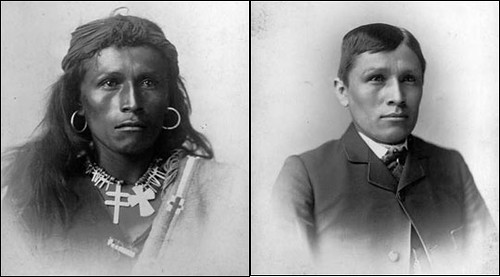
These boarding schools were happening at basically the same time frame America colonized the Filipines, in the early 20th century. Here we can see the "after" portrait as starkly similar to the "after" shots from Crone's albums comparing the "uncivilized" Native to the civilized one in a Western style coat and tie. The hair is groomed and short, combed in a way white people would find respectable.
Anyway, this was a really long post on what I took away from Bernadette's awesome presentation. I think the overall point of this post is that education is a vastly important weapon used by colonizers. Crone definitely knew this, which is why he reformed the educational system in the Philippines. Education is an institution that is widely seen as liberating, important, and necessary to success. Looking at the rhetoric of colonizers as pertaining to education, we can see how colonizers have used this positive idea of education in order to effectively colonize and conquer minority groups.
Subscribe to:
Posts (Atom)