
The piece shows a noble white plantation owners with their child living in harmony with their slaves. The inscription says something along the lines of how great slavery is because the slave owners were benevolent people who would do anything to ensure the well-being of their slaves. Like the Americans who wished to educate and civilize the Filipino people, pro-slavery advocates also wanted to project the image that they could do good for their people they were colonizing and forcing into slavery.
Obviously the reality of both situations, the American take-over of the Philippines and slavery in the South, was vastly different from what the colonizers wanted to portray, but I think Bernadette's point of how powerful images are is relevant here. If one was uninformed about the brutality and dehumanizing reality of slavery (which a lot of people were during slavery, especially in the North), the image above would seem to make sense and slavery would not seem to be that bad. Everyone in the painting looks like they are enjoying themselves, so what would one object to? The relevance here is Bernadette's point about how Crone and the American officials were the ones who were responsible for the image of the Philippines America saw. They were the ones who sent the reports on their progress there and who keep all of this photographic evidence to show that the Filipino people were able to be civilized.
The last point I wanted to bring up is the similarity between the images of school children and portraits of the Filipino people in Western wardrobe with those of Native and Indigenous people who were colonized by Europeans. NPR and Racialicious wrote great pieces on Native American boarding schools, which was essentially a way to "Americanize" and assimilate Natives into Western culture. The point of the schools was to remove any sense of Native culture from children so that they could no longer relate to their ancestry. An image from the article I linked draws strong parallels to the "before" and "after" portraits of Filipino people in Crone's albums.
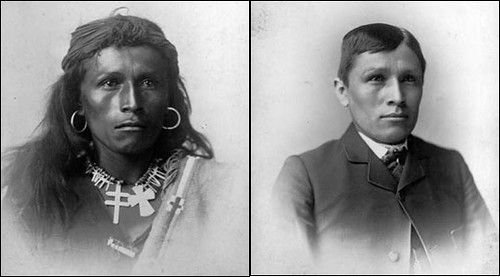
These boarding schools were happening at basically the same time frame America colonized the Filipines, in the early 20th century. Here we can see the "after" portrait as starkly similar to the "after" shots from Crone's albums comparing the "uncivilized" Native to the civilized one in a Western style coat and tie. The hair is groomed and short, combed in a way white people would find respectable.
Anyway, this was a really long post on what I took away from Bernadette's awesome presentation. I think the overall point of this post is that education is a vastly important weapon used by colonizers. Crone definitely knew this, which is why he reformed the educational system in the Philippines. Education is an institution that is widely seen as liberating, important, and necessary to success. Looking at the rhetoric of colonizers as pertaining to education, we can see how colonizers have used this positive idea of education in order to effectively colonize and conquer minority groups.

Nice post Ly!
ReplyDeleteI really enjoyed Bernadette's presentation and this post made some great connections between the situation in the Philippines and slavery in the US. The explicit comparison of propaganda used in both situations is quite interesting to say the least!
I guess history really does repeat itself which is why it's so important to take notice of such recurring events...
There's a lot more that I could say on this topic but for the sake of not rambling on our blog I'll just say kudos for a great post!
Excellent exchange--rather than contaminate it by adding my own words of wisdom, I'd just like to emphasize again how important images are in shaping public opinion. In the antebellum era, engravings and cartoon did the work of photography, although there was one man particularly, really the founder of American science, Louis Agassiz, who has the sad distinction of having been the first to use the camera to document racial otherness (i.e. slaves in South Carolina). That was in 1850 (see http://www.americanheritage.com/content/faces-slavery). He did the same thing again when he traveled to Brazil in 1865/66. I can tell you more about this if you're interested; I just published a book about the man.
ReplyDeleteRegarding Ly's excellent comment on boarding schools for Native Americans, let me recommend the autobiography of Charles Eastman, From the Deep Woods to Civilization (1916)--a devastating comment on the effects of the system. Eastman became on of the most highly educated men of his time--he became a medical doctor, but what his education "enabled" him to do was to tend to the victims of the Wounded Knee massacre...except there was hardly anyone left to tend to.
I think what we still need to talk about is the ways in which Crone assembled the photographs to form narratives--and why this collection makes them more powerful. One aspect we probably cannot go into but that is worth considering is how images of "civilized" Filipinos play off those in indigenous dress, for example, separating "citizens" from the "natives."